The Intersection of Market and Embarcadero as the Latest Site of Controversy
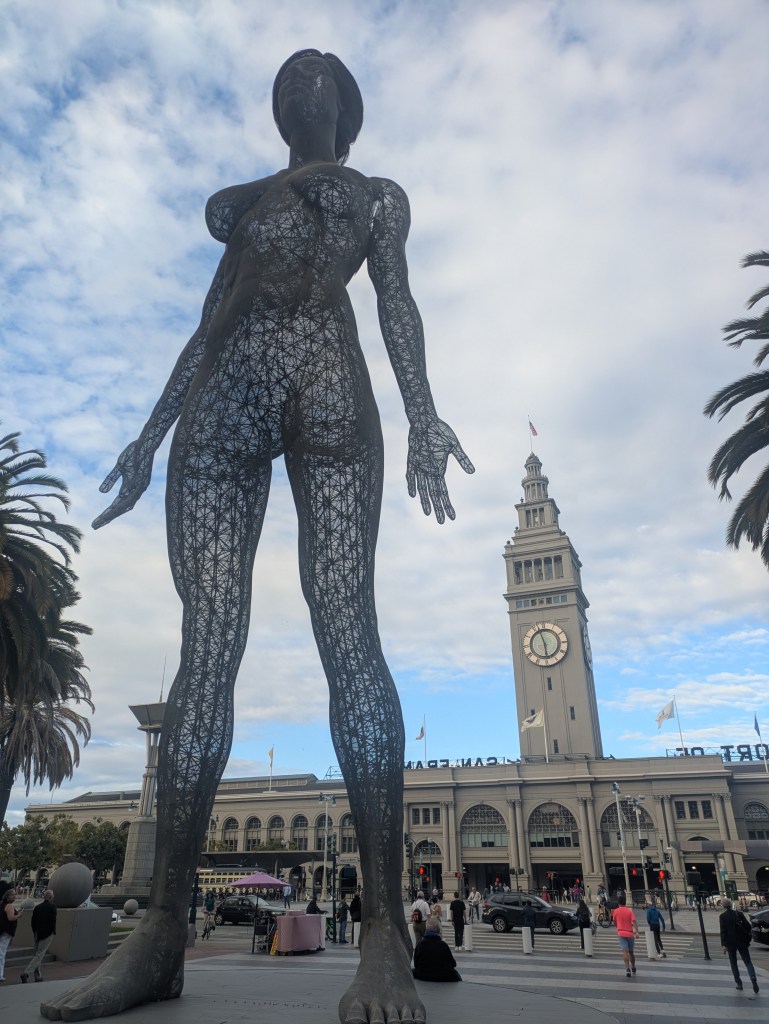
Is the omnipotence of the roving female nipple infringing upon the tastes of a weary public?
I’ve had a hunch, since a trip to Quebec back in March, that American public arts failure to arouse lies precisely its overt sexuality.
Ah, Quebec… with its kinetic sculpture, representations of nature, and odes to political controversies at the foyers of banks. On this trip, I was converted from someone who used to say, “I have a hard time connecting with sculpture,” to “America is incapable of good public sculpture.”
It goes without saying that nude women have been the bedrock of art from time immemorial. To take issue with that would be a fool’s errand. What I want to point out here, is that constantly catering to the male gaze is the lowest common denominator. The female form is sure to be, if not a crowd pleaser, at least not a crowd dis-pleaser. When you put together multiple branches of a municipal government, some of them art historians, most of them not, and ask them to agree on a public sculpture in America, they whittle it down to the least contemplative option, the thing least likely to offend. Too often that ends up being something abstract made out of rebar, or a female nude. I am afraid that images of nude females are so common as to have rendered themselves invisible. Like a wall of Andy Warhol prints, superimposed so many times as to make the image become less and less evocative with every grainy photocopy. In all its paternalized glory, we are accosted with the uncontested beauty of a perfect curvature of breast, hip, thigh, again and again and again and again and again.
Why does that matter? Are we better off with bad public art than no public art? Probably. What I think about is a third version of that famed experiment with the rats in a cage, who were given either:
a. a water bottle full of cocaine
or
b. a cage full of fun, enriching toys.
What about third version of the experiment, one where the rats get neither the diverse enrichment, nor the cocaine? Instead, they get a secret, dismal thing: a cage with 5 of the exact same wheel. Take a survey of sculptures and murals, and of course advertisements (hell, take it one step further and survey the tattoos, t-shirts, keychains, favored films of pedestrians) and unequivocally you will find the majority of the subject matter is the female image. The female image, and that’s all, with no deeper accoutrements of suggested meaning to gnaw upon with your 14 years of free public education (which did not include art, and it shows).
As of April 10, female art curation firm Building 180, The Union Square Alliance, Parks and Rec, and the San Francisco Arts Commission converged to bring us R-Evolution, a 45-foot-tall statue by male artist Marco Cochrane, whose mother, he says, was a woman. Standing kitty corner from the Vaillancourt Fountain and in earshot of the Ferry Building, these two public art monuments represent a convergence of compromises which make America such a non-contender on the worlds stage for good public sculpture.
A little background on each:
R-Evolution by Marco Cochrane (Pictured above), 2015
Michael Cochrane originally fabricated R-Evolution just across the water, in a foundry on Treasure Island. Originally created for Burning Man circa 2015, the sculpture has been looking for a permanent home and was slated to stand for 6 months at Union Square, until a team of engineers found that the parking garage beneath the plaza couldn’t support the weight of the sculpture. Enter Parks and Rec and the SFAC, who held a vote which passed 11-1 and exchanged a few emails, and voila, you have a metal mother turning her back to the Ferry Building. Usually, such an installation would require months of public comment, but under the extenuating circumstances… a series of executive decisions were made.
While the city has not bought the sculpture, it has spent $300,000 on its installation, working with Building 180 on organizing its installation, and the Sijbrandij Foundation, which owns the piece
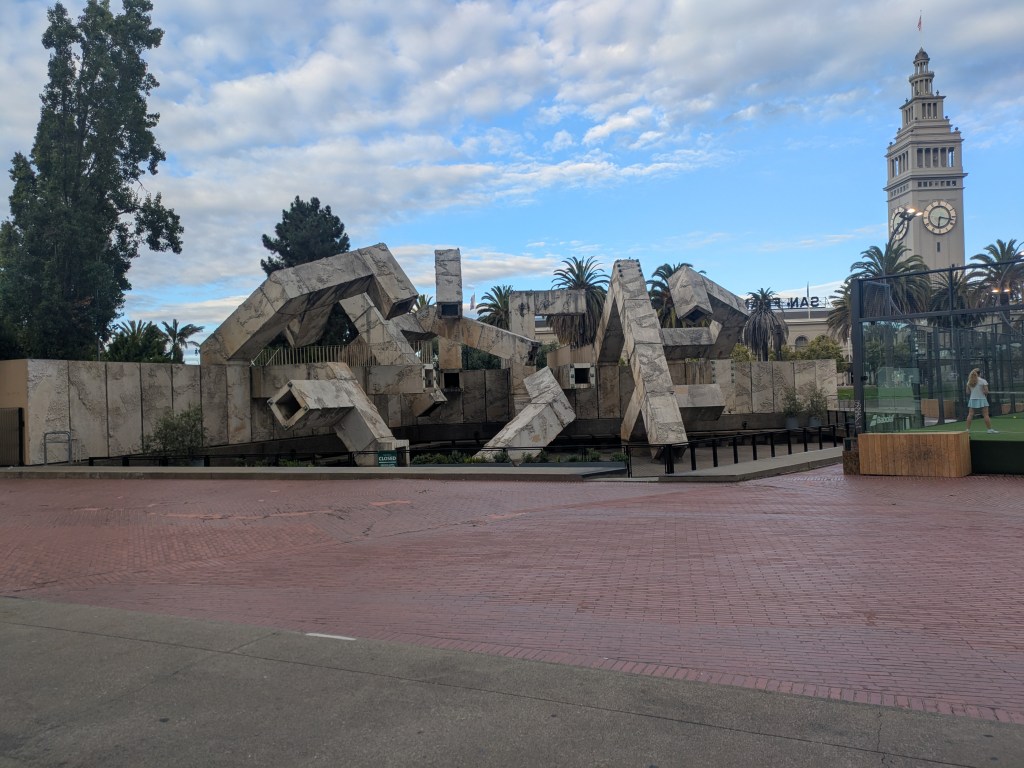
Quebec Libre! by Armand Vaillancourt, 1971
This fountain was erected as part of a beautification project in lieu of the ugliness of the highway that used to border the city on Embarcadero (where we now have the promenade). At the moment of its dedication, the artist spraypainted ‘Quebec Libre!’ on its facade, a message relating to Quebec’s nearly successful attempt to secede from Canada.
The brutalist structure was surveyed this year and was found to have traces of lead and asbestos, as well as several structural issues that threaten public safety and render moot the intended interactive elements. Last year, the pump also stopped working. The fountain is now drained, and surrounded by a fence, while the SFAC and parks and rec hold meetings and consult with each other about what to do with it. Estimates of $12-17 million (I saw conflicting estimates for $29 million) are projected toward the repair of the fountain, part of a $30 million project to revive the whole of the plaza. It would take an estimated $300,000 (I also saw estimates for $2.5 million) to simply disassemble the fountain. It costs about $100,000 annually to run and maintain. A nearby building was charged with responsibility for the upkeep of the fountain, and while this building has not met those responsibilities for the last 54 years, it is now in support of the fountain’s disassembly (at no cost to them).
AND WE’RE BACK
While R-Evolution will be a short blip in the memory of all who have trespassed her ungirded loins (the installation is a temporary one that went up in April of 2025) many San Franciscans, including 96-year-old Vaillancourt himself, are making a scene to prevent the destruction of the Vaillancourt Fountain. As recently as last week, Vaillancourt sent a cease-and-desist letter demanding any actions taken to disassemble the fountain cease, backed by 6 architectural and cultural institutions (in response to a formal request submitted by Parks and Rec to remove the fountain). This came after two hearings in July by the parks department, where representatives stated it was simply impractical to restore the fountain. Objections from the community resounded at the meeting, including by Vaillancourt’s own daughter. Pressure is mounting from the public in the form of more meetings, newsletters, national campaigns, and petitions to save Quebec Libre!
My own recollections of Quebec Libre are of how accurately it reflects, on a typical overcast, pigeony day, what San Francisco is at its most unassuming. Chaotic like jazz, wet and dripping, a cultural magnet for skateboarders, diseased birds, and disrespected public property thrown in its waters, the fountain isn’t a reflection of the city’s highest idealistic image, born from the mouths of its tech-oligarch babes. Rather, it is a reflection of what is greatest about San Francisco, because it is a close mirror of what San Francisco actually is, has been, and will continue to be: It is a site of mixed revulsion, gloom, political outspokenness, and ceaseless flow. It is a site of our support for an artist’s declaration of freedom for his own homeland, a testament to the city’s constant reckoning with a desire for liberation the world over, a potent symbol of the human spirit. Wrapped in the architecture that least represents the fleshy vulnerability of those who represent that insolence, it perhaps reinforces the idea of a sturdy indolence that pushes humankind forward despite oligarchy.
Despite the best intentions of naive men who take too many psychedelics to realize they don’t have all the answers – who were not goaded into questioning their place in liberating women by creating representations of women – whose well-intentioned artist moms let them run wild one too many times in the grocery store, I am not feeling liberated by that giant, idealized female figure.
R-Evolution does not reflect a San Francisco where artists can design deeply thoughtful work for the public. It does not serve as evidence that we are materially supported in contemplating our existential hangnails. It does not prove that we can, in good faith, entangle public agencies with arts commissions and still come out with something worthwhile.
It does reflect the state of public art as, still, a monopoly of the male gaze: a male gaze we have repackaged today as acceptable because of its benevolence around the untoward lifestyle choices of women that men benefit from. Despite posturing the work as a symbol of female empowerment, its wan nudity supposedly symbolizing liberation, R-Evolution serves to reinforce that the highest form of art is equivalent to the highest form of acquisition that men can imagine for themselves – a hot woman. In that way, it, the female nude, is not really about us, it is actually, about them.

Leave a comment