A collection of strange, subtle and symbolic pieces spanning sculpture, video, quilting, painting, and holographic photography filled the cement floored and white walled gallery of Southern Exposure. I happened to walk past in the last hour of the last day of the exhibit, Saturday afternoon, March 7th, and was surprised to find this experience at a small non profit gallery that has been running exhibits and community programming in the same location since the 70’s.
Many of the works on display did not feature labels, so although I have a list of participating artists, its hard to find the proper attribution for every piece. Additionally, and perhaps luckily, most pieces did not have an additional plaque explaining the work.
Looking at these works felt like peeking into the dialectical worlds of people from other countries, with common sights, objects, and geographically significant materials, even, that shape the immediate world. The significance of these materials was deeply felt and immediately transmissible to the viewer. I was particularly impressed with this exhibit because many artists today aspire to make work about the self. I don’t often see success in these attempts, because they often fail to speak more largely to identity in general. They tend to read like diary entries. These, however, stood out to me.
In this case, the identities depicted were lyrical, visceral, personal. You could almost smell the inside of the houses that the pieces represented, as you experienced each installation.
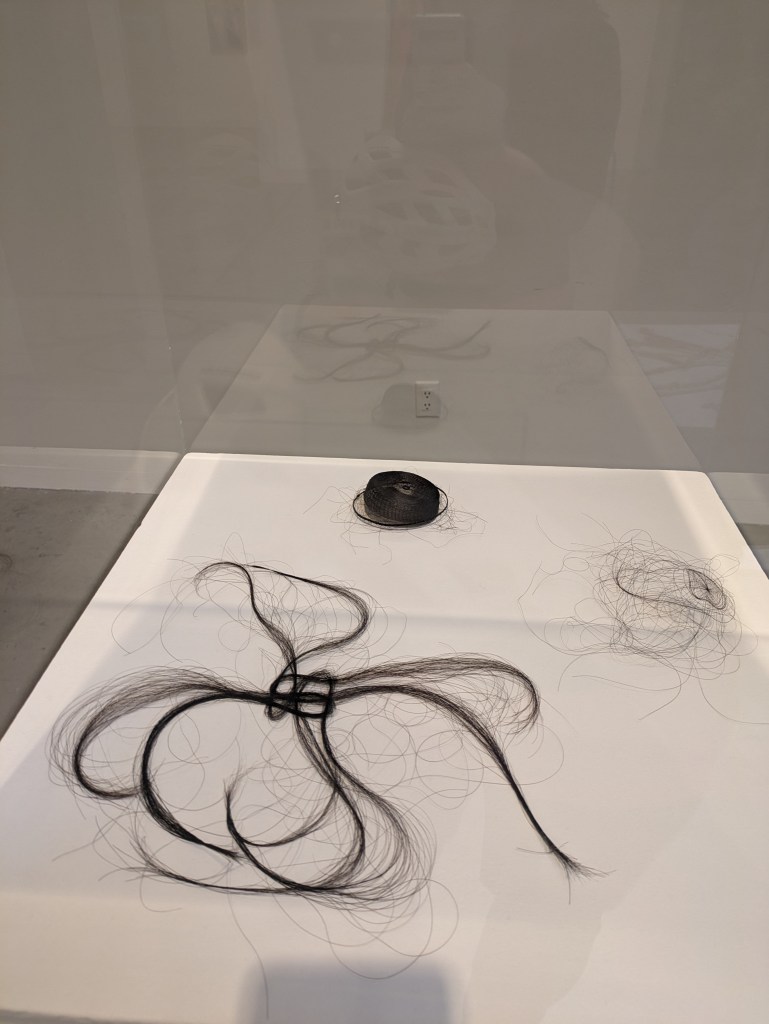
The first work I came upon was a display of one of a painstaking and delicate little sculpture, the beginnings of a basket woven with a single strand of hair, along with two other examples of basketry. Two thick lochs forming the knot of origin for any basket, like interlocking S’s, and a basket three inches in diameter and an inch tall formed from a sort of thread of hairs. The symbolism in work like this is so dialectical, and I would do myself a disservice by trying to describe what it means without knowing the artist and their ethnicity, but I also don’t think it needs much explaining; a long practiced tradition, rendered with body parts, namely hair, which has a notorious history in terms of oppression and resistance, symbolism, power, and beauty in indigenous culture.
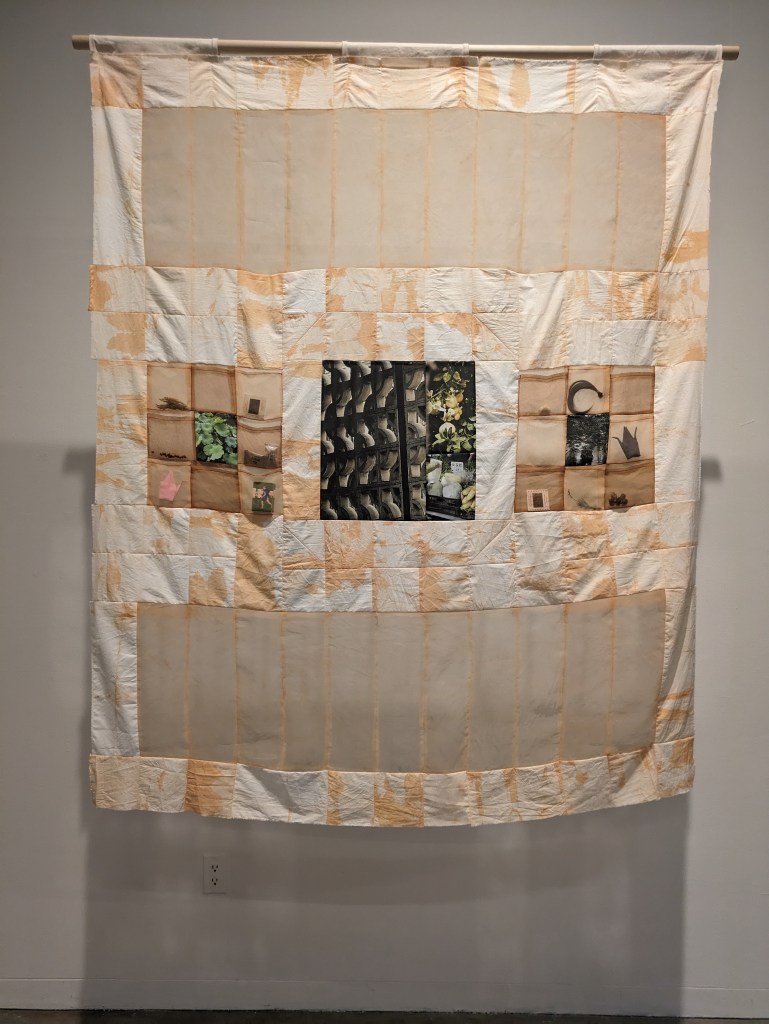
Next was a quilt of hand printed patterns and non-opaque pockets filled with seeds, cedar tree needles, origami cranes, hair, and other small objects that spoke to people having a relationship with the land, the body, and cultural traditions, all compartmentalized and documented. It hung quietly on the wall near the baskets under a box of glass.
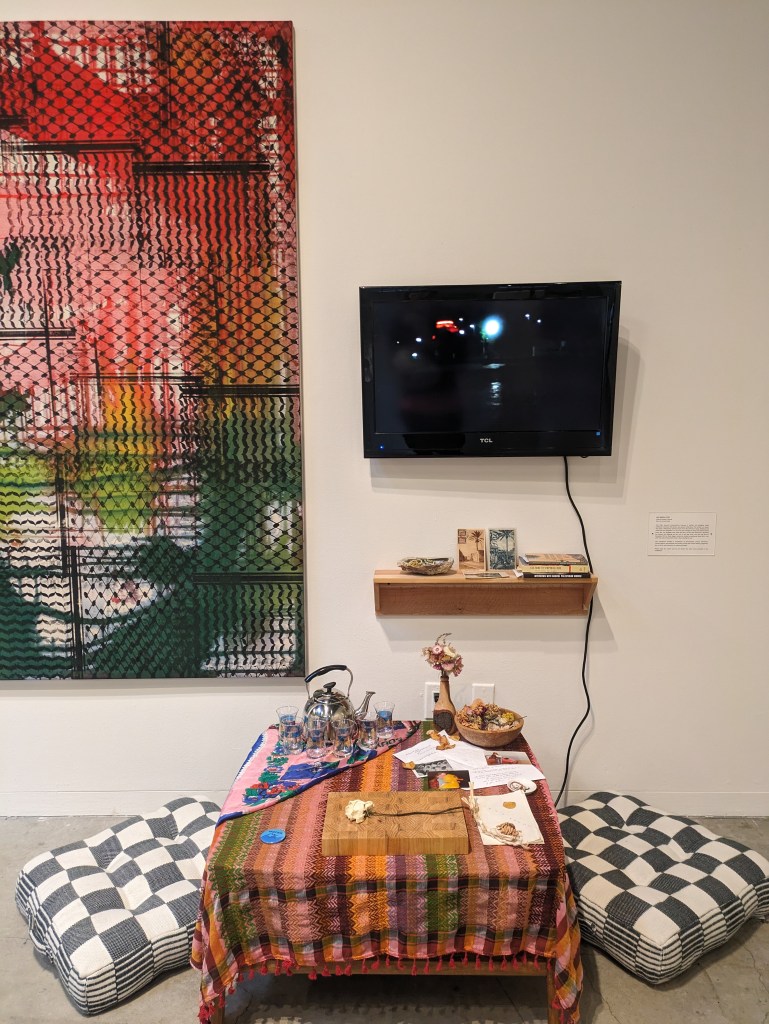
Turning the corner was a table adorned casually with a tea set, letters, photographs, a keffiyeh, and two cushions on the floor next to it, welcoming the viewer with a hospitable still life. Above it were a few bookshelves with books about the history of Palestine and titles that suggested sovereignty and resistance, and next to them a tv displayed an artist interviewing her mother about raising children and having a family in occupied land. The interview feels natural and intimate, the wisdom imparted lands like an indulgent snippet of an overheard conversation you would turn over again and again for days.
Looking at work like this usually requires extant information. Because of how astute this collection of work was, I thought the works spoke really directly to this kind of nostalgic preservation of what Home meant for the different artists in the show.
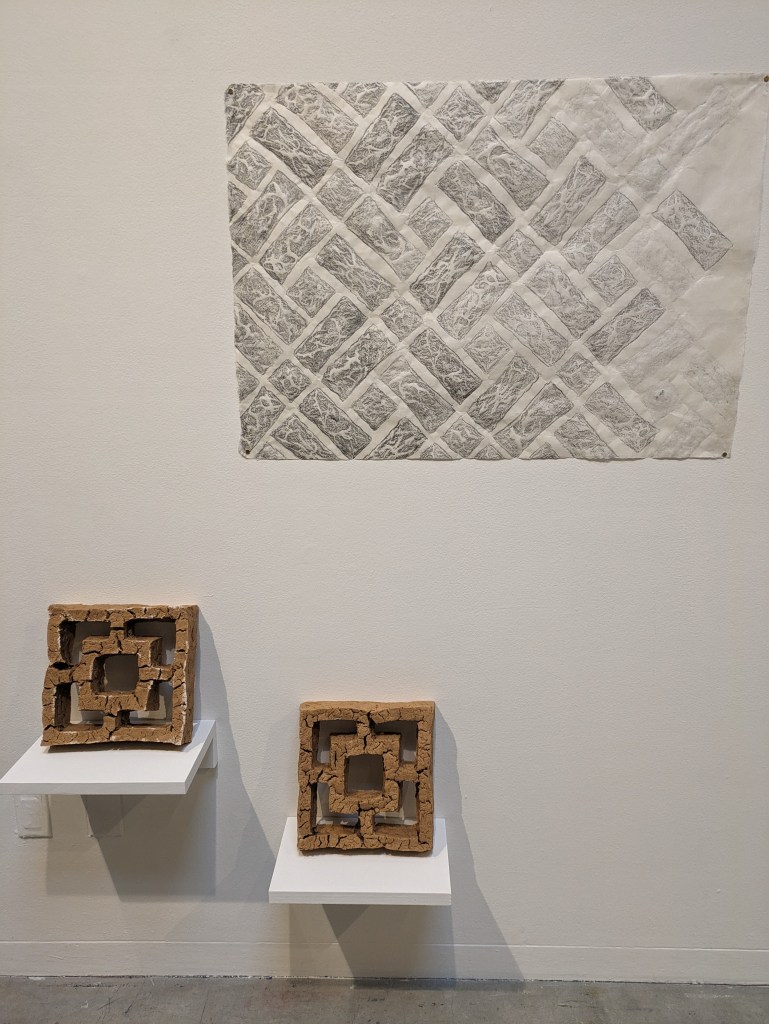
Next was a rubbing of a brick wall, a chevron pattern emerged and below it were two bricks formed from what looked like unfired clay. It flaked from the drying process and peeled like close ups of skin, and as the viewer walks on, a corner of the floor was lain with tiles etched very lightly with a floral pattern. Laying on these was a TV with a camera pointed down to a sea of red dirt clods, in the background two people can be heard talking about the clay.
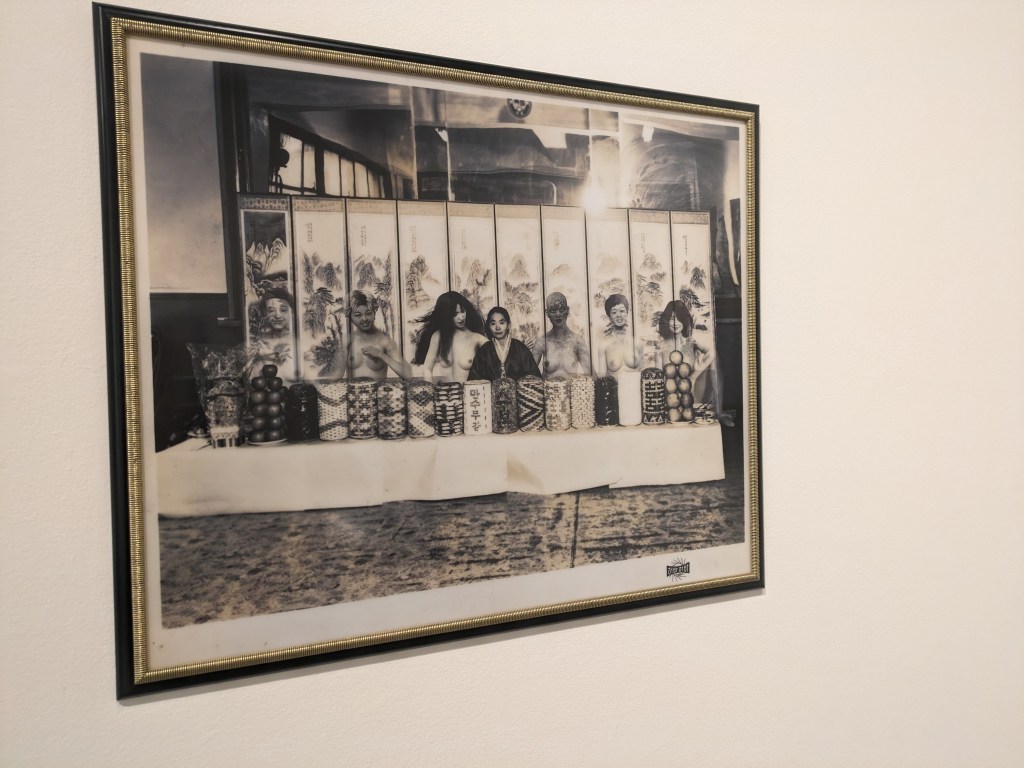
The next piece had a holographic photograph of a woman sitting alone at a table in black robes. The table is long and she has a Mona Lisa smile, but as you walk past, eight characters appear, flanking her. All of them are women, and their hairstyles and clothes are all different. Some look modern, some look ancient, but all look supportive of the woman in the center. Nearby is a CGI rendering of the women in the picture, laying on each other, gigantic, over an otherwise empty city. Skyscrapers serve as pillows and arm rests for the women, who laugh and caress each other familiarly. A single sound occurs repeatedly, like a wooden hammer thwacking a wooden spike.
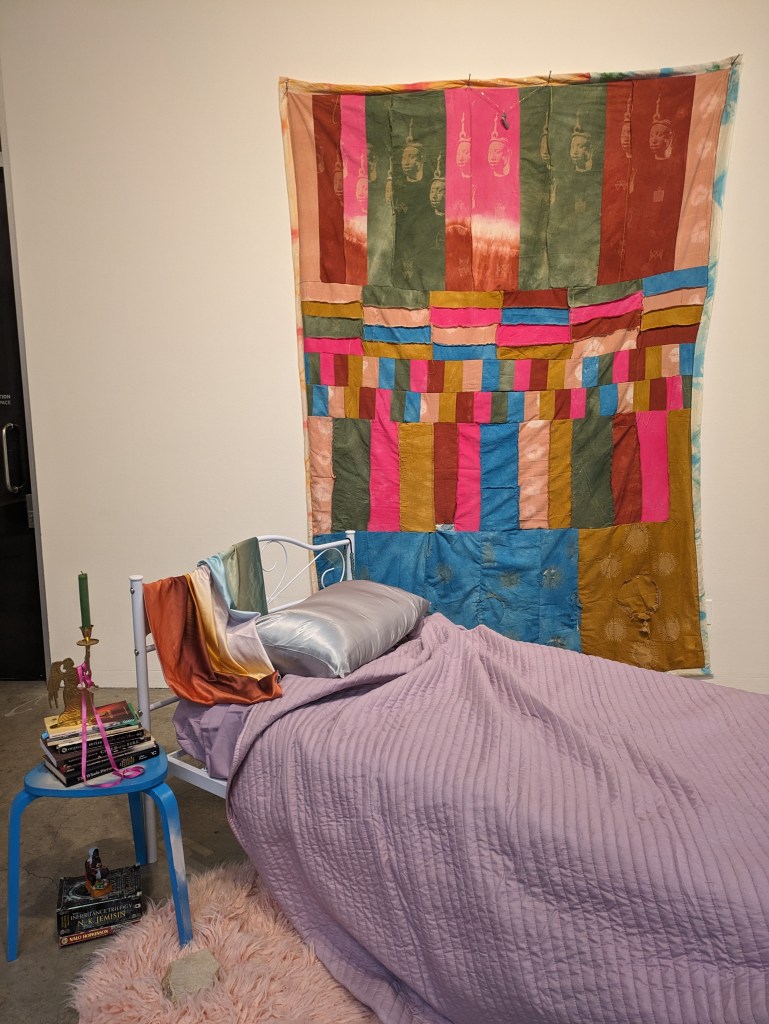
Finally a bed juts out diagonally from a wall, with another quilt hanging above, this one with printed faces of buddha’s. A small table stacked with books tells you about the person who might occupy it, and the bed sheets are mussed.
I have heard so much about beds in an art gallery. From Tracey Emin’s Bed piece in the Tate in the 90s, to John Lennon and Yoko Ono Bed In, to a piece I saw art Art Basel of an antique bed that the gallery owner said “Kept bringing people back over and over again,”, the bed is this repeating motif in art. There is no place safer than the bed. The bed is where we sleep, where we stay late to feel relaxed into the morning, its where we have sex, and it’s often where people die in the most peaceful fashion. Showing strangers your bed is showing them the place where you are, at the literal end of the day, you’re most vulnerable. Is that the best way to make a self portrait? Is our most vulnerable state our most true? Or do we just really need to make a case for the value of vulnerability at this time in human history? The bed is oft dismissed as a lazy sculpture, hardly deserving of space in an art gallery, or at least in Tracey Emin’s case it was. Yet here we are again, and all the questions that came up the first time are still here. Albeit, the person occupying this bed seems very different than Tracey Emin.



These kinds of pieces of art force one to breathe in the air of another atmosphere, and in that way it plays with the notion of an art gallery. This exhibition, I thought, was a formidable contender in the contest for who determined the spaces impact on the people inside. The work was precise. I came away with the feeling that I had been shown what it felt like to be a member of a family in a bunch of small, well crafted metaphorical ways.
Home is where ancestry and materiality combine to make a place. It is put together with objects found, inherited, bought, and given. Each of these is infused with the practices, religions, available materials, and values of your geographic home, the wealth and habits of the members of the family, and the number and ages of people in your home at present and through time. If a snapshot is good enough, you can tell a lot of these things with some investigative looking. Its incredibly personal to take on this idea as an art form, and understandably prescient as we stand at the helm of purposeful erasure, and at the tail of many many previous attempts at erasure on pretty much every non-white ethnic group. The works in this show, I believe, revolved around themes such as this one, a preservation, a wistful snapshot of nostalgia, a heralding of artists roots, reckoning with inherited values, traumas, beliefs both limiting and infinitely true.
1-2. Leymusoom Is Holding Us, 2023
Video with Sound
6:32 minutes
$6000, Edition 1 of 5, plus 2AP
3-4. Heesoo Kwan
Premolt 1, 2022
Framed Lenticular Print
41×34 inches
$3500, Edition 1 of 2, 1AP
5.Jezabeth Roca Gonzalez
Isa Flotanta, 2024
Video with Sound
4:51
voice narration by Eva Angeli Sanches Mendez and Abuela Luisa. Collaborative scenes with Jaycob Figueroa and Shaleyka Figueroa. Isla Flotante was developed at artist residencies: The ecologies of Precarious Abundance: Queer life and nature at Banff Centre for Arts and Creativity; at Hidrante in San Juan, Puerto Rico with the support of Dedalus Foundation; and with ongoing support from the inspiration labFoundation; and with ongoing support from the Inspiration Lab Artist-in-residence program at the Universiyu of the Arts in Philidelphia, PA.
Tierra Prensada, 2024
Clay and soil
Variable
NFS
6. Rochelle Youk
Meju/[omitted]wall, 2024
Graphite on Hanji
26×37 inches
$2200
6. Rochelle Youk
Meju/ [omitted]breeze lock no. 1, 2023
Soybeans, Salt
12x12x4 inches
$1600
meju/[omitted] breeze block no. 2, 2024
soybeans, salt
12x12x4 inches
$1600
*words in titles are omitted because I dont speak korean and cant trans;late the symbols from the price sheet
7. yétúndé olágbajú
In Your Dreams, 2024
Installation with quilted muslin, twin sized bed, night stand
dimensions variable
contact for pricing
8. Rochelle Youk
gat/[omitted] sketch no. 2, 2026
Hair of the artist
9″x6″x4″
$2400
9. Nalan Al Sarraj, Lulu Thrower, and Saif Azzuz
Her Green Eyes, 2024
Video with Sound
13:36 minutes
Closer to Home, 2024
Wood, keffiyeh, tea pot, books, photos, postcards, sweets
Variable
NFS
Saif Azzuz, Come, Let’s Talk, 2024
Acrylic on Canvas
80×60″ NFS courtesy of the artist and Anthony Meier
10.Jes Young
All of our Flourishing is Mutual, 2024
Recycled cotton bed sheets, silk organza dyed with locally foraged loquat leaves and clay, photo printed on silk charmeuse
60×48 inches
$8000

Leave a comment