An exhibit of 11 women who attended Mills and studied under renowned Chinese American painter Hung Liu; How to embody joy in a time of immense terror
Last night was the opening of an 11 person exhibit featuring works by former pupils of renowned Chinese American artist Hung Liu. Housed in the Mills Art Museum, the works were larger than life, and the energy of show-gazers swilled and rocked the walls of the dignified palace, enlivening the joyful work with obvious love for the painter, educator, and mentor of the artists therein. I witnessed people hugging, yelling, and excitedly clasping hands. Artists took pictures in large semicircles in front of each others work, introduced their children, and shared about their lives, all while standing before their work.
I was there to see my own former painting teacher, Gina Tuzzi, along with people I attended Cal Poly Humboldt with, in a delightfully mirrored experience to the dignified and accomplished artists on view.
Before we talk about the ways Hung Liu’s mentees exhibited parallels in their messages, their compositional style, and their inventive use of materials, we should talk a little bit about Hung Liu herself. Before I begin, I am behooved of my own self to say that condensing the life of an artist as self-possessed as this is necessarily a disservice. Words pare down the lives and experiences of people who so relentlessly live on their own terms. They have to, that’s the point of words, to make the lives, experiences, and meanings of things transferrable in the simplest terms, and create stories. I would urge the reader to try and feel the full breadth of a person making the decisions Hung Liu chose to make. In her life as an artist, a Chinese woman, and a person born on the cusp of a cultural revolution, she just didn’t listen. What would that look like on paper? Canvas? Lithograph glazed with resin? Luckily, we have some artifacts. More ‘luckily’, she was recognized in her lifetime for crafting these artifacts.
To surrender to words(grifted from wikipedia, an exhibit of hers I saw at MOMA, and the bio of this exhibit, as well as anecdotes from her pupil Gina Tuzzi): Hung Liu was the first Chinese artist to leave Mao’s China to study art in the US and have a career around it. At 35 she came to California to receive her (second) MFA. She gained recognition in the 80’s for creating a tongue-in-cheek painted version of her green card, changing her birth date to the date of her immigration, and her name to “Fortune Cookie”. Some years later(1993/2013), she created an exhibition wherein an intersection of railroads is piled high with thousands of fortune cookies, commemorating the brutal ways Chinese labor was exploited to unite the west with the east, at the selfsame museum where this exhibit was on view(Mills College Museum).
These works seem distinct from the not-so-color-fast dedications to history, memory and culture her more prominently referenced paintings embody. On backdrops the color of tea, Liu painted from a personal archive of historic photographs of common Chinese people. Contemplative, sentimental, and evocative of memory, I get a sense of nostalgia for a China that Liu maybe didn’t know, or maybe was afraid of forgetting. With suggestions of traditions, pass times or common sights that were dispensed of or hidden as pre-communist relics, per the revolution that took place formally one year after her birthday, she paints prostitutes, children with bound feet, and farmers. She painted from pictures she was forbidden to take, but secretly she did so anyway. She then recreated them in her studio. Alternatively, her green card and pile of fortune cookies are political, acerbic, and perhaps beneath all of that, angry.

Hung Liu
White Rice Bowl, 2014
Mixed Media
Whether her work took a sudden turn, or she had one foot in each world, eludes me. I gather she had a sense of humor, and liked to inject levity where it felt natural. Keeping all of this in mind, the work of her students on view was indeed, political. It was indeed, a testament to the environment. It was indeed, an exploration of the self, but, refreshingly, not navel gazing. It makes me wonder what she would say, do, or omit in order to get this message across to her pupils. Naturally, hidden messages were a consequence of her formal training in China, where art school students were taught to convey images that China deemed appropriate, dignified, and of the essence of the New Order (in other words, propaganda). I take a stab that this was the bottom line in her classroom: speak to issues, speak from your heart, but be humble about it. Subtlety, consideration of form, and application of unique materials were the mastery I saw most prevalent in this collection. A small, intense family. A supportive network. Play, but in the most carefully applied, neurotic sense of the word. Or maybe it just seems that way to an obnoxious and heavy handed painter such as myself.
Monica Lundy’s work was perhaps the closest work to Liu’s in both form and content. Portraits of the dismissed, imprisoned, or socially admonished were the subjects of her minimalist portraiture, akin to Liu’s subjects sometimes being prostitutes, from her archival photographs. Lundy similarly aimed to evoke memory by using burned pieces of paper to create highlights and shadows in her subjects portraits. Technique and use of materials like coffee and clay to build up layers in her work evokes sepia, creating an atmosphere of subjects who were forlorn.
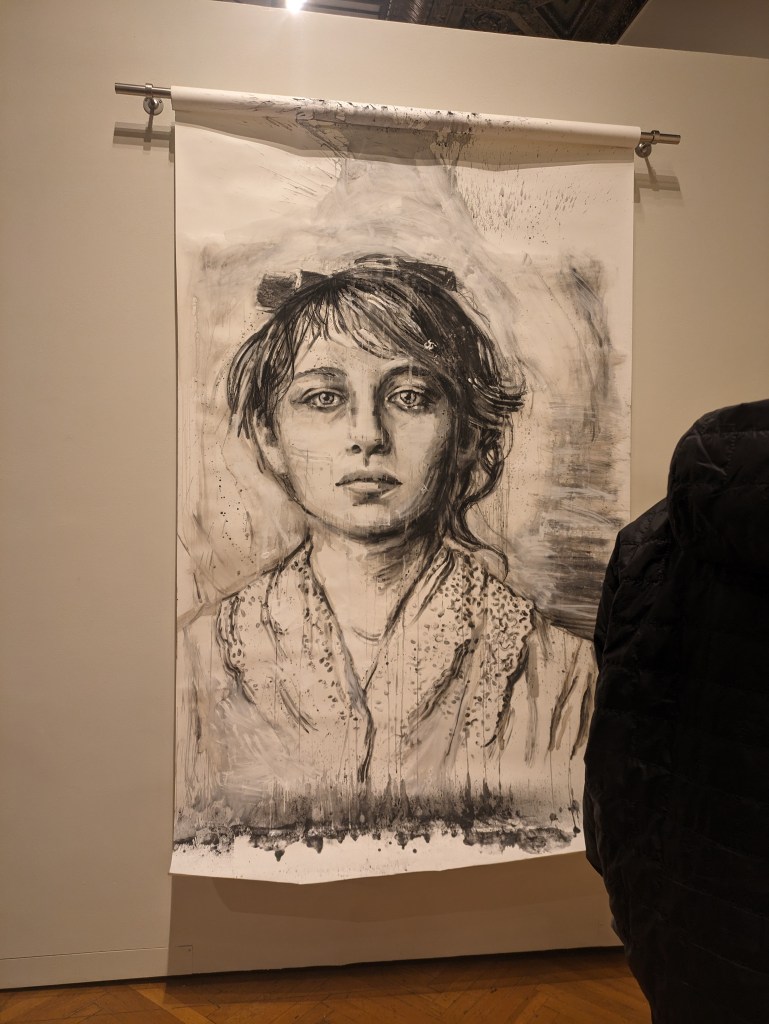
Monica Lundy
Eusebia, 2018
Coffee, charcoal, gouache, burned paper on khaki paper
Yoshiko Shimano’s work embodies a dialectical position of recognizing modern terror while celebrating life and its capacity to heal for its own sake so explicitly. I enjoyed the straightforwardness of her artist statement and the unique process she seems to return to again and again in all of her work of using photographs, mono prints, and Lino cuts to evoke a feeling of memory in her own visual language. I found some interesting sort of thread between her use of the sunflower, Ai Wei Weis use of the sunflower seed, and Liu’s use of the fortune cookie to represent a larger idea of forsaken people enshrined in the dignity of everyday objects.
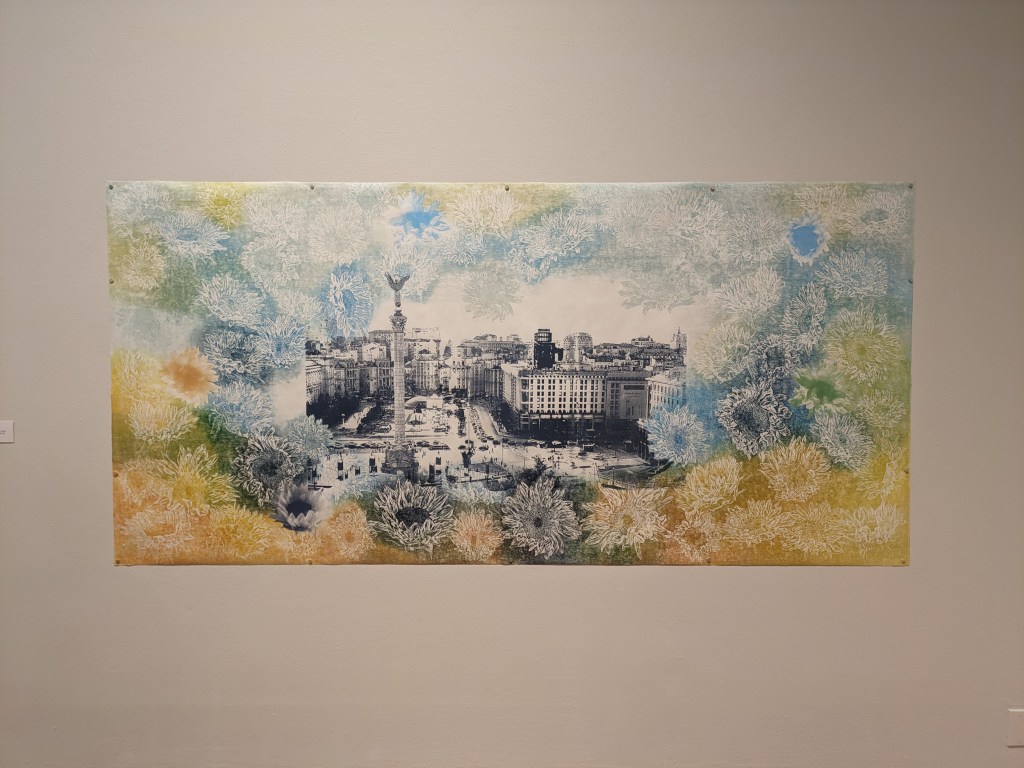
Yoshiko Shimano
Healing Land and Healing Souls – Kiev 2023
Silkscreen, wood mono print, linoleum cut and stencil
Lien Truong’s work strikes a defiant tone, like Miles Davis’ Bitches Brew. The dark colors that make up the atmosphere behind the silk ovals that seep from its shadows recall depictions of science fiction book covers and movie sets about dystopian futures. The hanging silks obscure amorphous bodies, feathers, and clouds that recall Japanese block prints. These works feel angry, demanding, and turbulent, in a way that acknowledges the viewer as someone strong enough to witness pain, and a painter strong enough to paint it. Sex, war, death, nods to eastern history and art, and the universe at large blend together in a painting that is pure metal.

Lien Truong
Patsy Takemoto Mink ain’t afraid of the Dark
oil, silk, acrylic, gold pigment, vintage silk mourning obi cloth on canvas
Danielle Lawrence exhibited three large works in the exhibit wherein a pastiche of dyed, wrinkled, stretched and stapled fabrics hung on each other and carelessly into the viewers space. These works were difficult to digest and left me feeling confused and pedestrian. This made me kind of angry, the objects before me felt obtuse. I have learned to relegate this kind of exploration of cast aside materials to depression era sculptures made from left over house paint and old pieces of wood garnered from the dump. Bringing this kind of exploration of materials into the 21st century and (I hate to say this) by a woman, feels like a reclamation of an art form that was practiced mostly by men when materials were scarce and art has to be masculine, American, every-man-ish. In a time where materials are so flush that they clog our ocean life’s necessary breathing holes, I struggle to look at them with anything but mild distress. What I delighted in was the idea of a artist standing and walking around her big canvases, muscling to stretch, manipulate, and force. The focus on the cerebral practice of balance in abstraction are some things my shriveled monkey brain can recognize as strengths for this sculptor/painter/id dweller.

Uh Huh Her
Denim, leather, canvas and watercolor on wood
31.5″ x 25”
2020
The works placed front and center of the exhibition, wrapped fully around an entire wall, were the works of Nancy Mintz. They were composed of brass and paper and so directly conveyed a simple, childlike observation of the joys that nature can bring. Look at these sweet ginkgo leaves! So cute. I loved the way she brings about her forms, the simple engineering of clouds, conk mushrooms, and webs were just delightful.
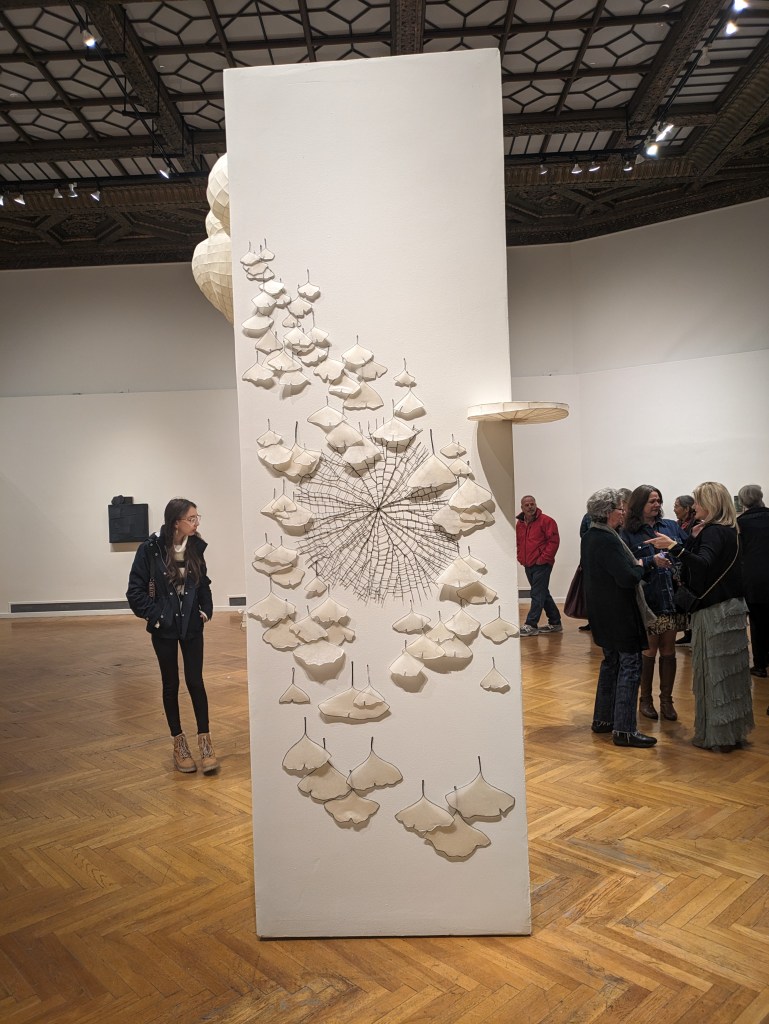
Nancy Mintz
time, being, 2024
brass, paper
Rachelle Reichert’s works were for me some of the most intriguing. They were a collision of professional material praxis, artist turned activist, and hydrologist turned pop artist. The execution of these works were so inalienably clean that they felt like corporate art. Birds eye view photographs of watersheds disturbed by lithium mining, she aims to shed a light on the ways we extract commodities at the expense of the earth. Without context, these picture would seem like simply pictures of watersheds. But why would someone go through the effort of printing them on colored aluminum and mounting them to panels cut into quarter circles vis-a-vis Yves Klein? Maybe to seduce people in to looking? Maybe to sneak eco-feminist ideas into the corporate offices of the thieves of the land? If only I would do some more reading on her to find out…

Ponds
Archival Pigment Print on Aluminum over Panel
2021
Gina Tuzzi had three works on view, the largest pictured here. This work was a uniquely direct exploration of the self. She gives a deadpan gaze, crouching alone in a dappled riverside clearing, with a small dog standing close by. Light washes of paint impressed upon me the confidence of her hand in applying each stroke, nothing revised, and the economy in the face and body as austere as the expression. Along the sides are her signature pop-cultural adornments, pictures of artists she has studied carefully placed to seem haphazard, like postcards along the borders of a teenage girls mirror, next to surfboard decals and other iconic Santa-cruz counter-culture doo-hickys. This work garners long looks for its summery color pallet, the relaxing quality of the depth of field, and the of-a-certain-time addition of cool stickers.
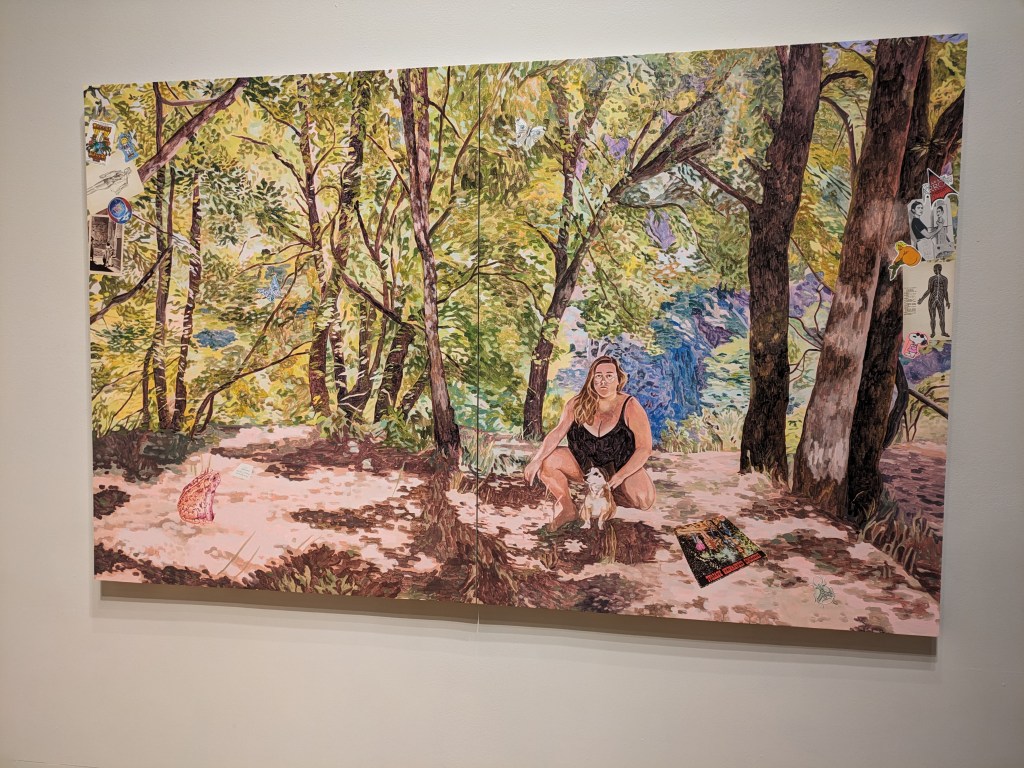
Gina Tuzzi
The Toad and The Junebug 2023
Acrylic on panel
I saved my favorite for last. Nicole Phungrasamee Fein‘s work elicited excited buzzing from people crowded around her work. I waited behind two women who talked excitedly about her process for some solid minutes before I was able to get this terrible picture that doesn’t do the work justice at all. She makes these painstaking paintings using the tiniest dapples of watercolor paint, and the works can only be seen extremely close up, or fairly far away, to appreciate the actual genius of her process. Encountering work from someone so dedicated to a process that no one else could ever conceivably appreciate as much as she pains herself to actually do is something you have to respect. Her dedication to using tiny atomic particles of very pure pigment to make the things she makes is the obsessive work of someone who has a VISION, man. Plus they look a little bit like comic books, but aren’t really graphic, which I think is an interesting fusion of worlds. Appropriately named for the show title: Look Up To The Sky, this work is titled Sky, 2023.
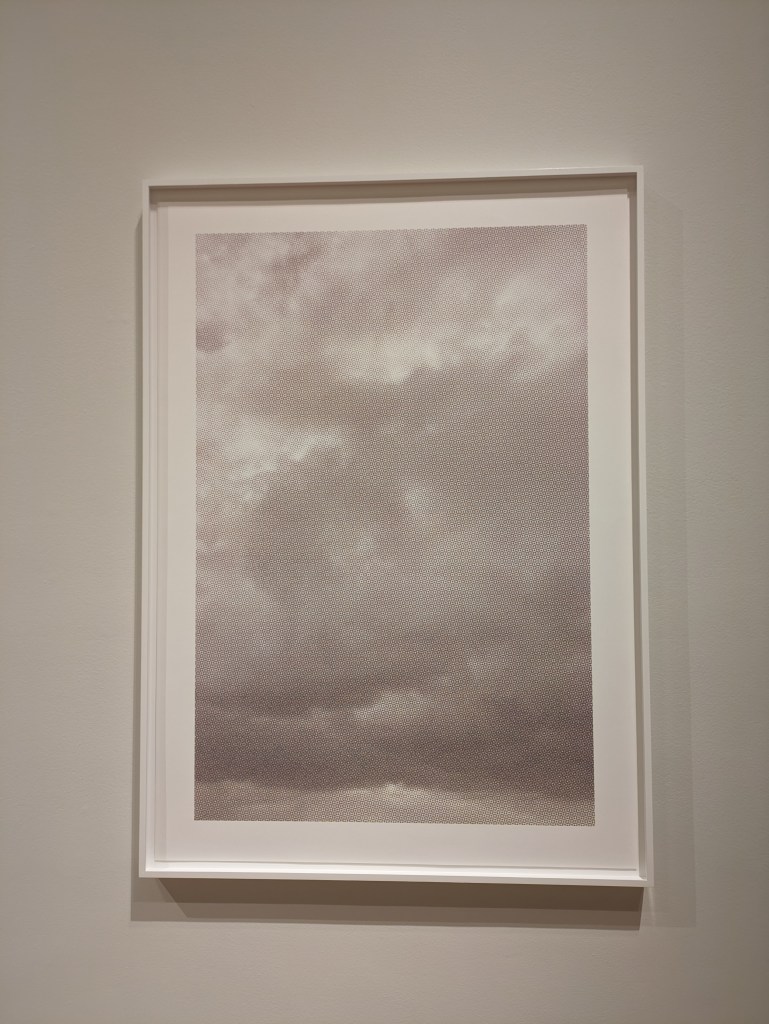
nicole phungrasamee fein
sky, 2023
pigmented felt tip pen and archival ink jet on rag paper
Also on view were the works of Rosanna Castillo Diaz, Bambi Waterman, and Susan Preston.

Leave a comment