On motherhood, making, and existence
Thursday January 4 marked the First Thursday of 2024 in the Tenderloin district, a monthly event highlighting the lively art scene in the citys grittiest neighborhood. Jasmin Cañas work was on exhibit at Mothbelly Gallery, a fixture of Larkin Street just above Geary.
The (new-ish) gallery has been in operation since 2020 and houses works by artists with an unspecified ‘outsider’ vernacular, and a certain queer-adjacent verve. Per the galleries website; “Lastly, we are a not-for-profit platform, fiscally sponsored by 501-c3 Intersection for the Arts, and we embrace DIY ethics of accessibility, sustainability, and anti-consumerism.” That tells you mostly everything you need to know.
The gallery has a welcoming feel, the space spans a not-neglible 15’x30′ room with patrons exchanging familiar greetings and newcomers being greeting by enthusiastic co-op members and friendly community members.
Jasmins show contained a range of works varying in size from less than a square foot to roughly 4×4, and a single sculpture.
The work spanning the left side of the room tracked a narrative that seemed coherent across the works, explorations of identity and selfhood as a woman, mother, and consciousness-bearing being. On the right spanned a slew of work grouped together by media and subject, providing insight into the breadth of the artists practice. Themes around identity, motherhood, and existentialism abounded. The treatment of painting, itself, as a medium was respected and treated with care by the nimble hands of the artist, with the figuration of the self a major focus of the works as subject matter in the precise, tiny strokes of an illustrator. The artists body was shows in an array of poses which obfuscated the predisposition that a woman’s body might be depicted as a sex object in all explorations of the nude female form, an excellent foot to start off on.
The postcard of the show was also the largest work, a power move of a self portrait. Seen eating doughnuts in a crouched position, the skin a dark ebony abstraction of the artists actual skin color, her figure is fleshy, contorted and framed perfectly centered, legs asunder and belly soft and relaxed in a sea of pink. Re:Goya, she is eating the doughnuts with relish, hanging one above her gaping maw between pinched fingers, and scattered around her feet and rendered crystallized beneath an eighth of an inch of epoxy resin, are more doughnuts, oranges, and other fruits and sweets on plates depicted with the righteous love of all things living and supporting life. If Neruda could paint, he may have painted these. Media mixture in many of the works suggest that play was an important aspect of the process of creating the works. I found the treatment of the subject matter light hearted and playful, a sort of counter-treatise to John Bergers assertion that “Women constantly meet glances which act like mirrors reminding them of how they look or how they should look. Behind every glance there is judgment.” (from Ways of Seeing).
Alternatively, it could be an affirmation of John Bergers astute writ. It provides a scene rarely depicted. A woman not posturing to be seen, but still, obscured by darkness, nevertheless ornamented with shiny pink donuts. Shrouded in the protection of the dark, Titan is gorging on doughnuts in total isolation, and having birthed the children herself, consumes fruits and sweets instead.
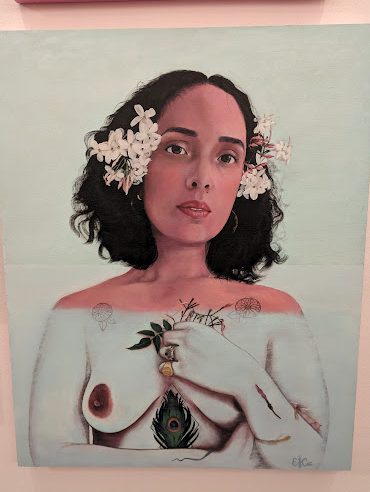
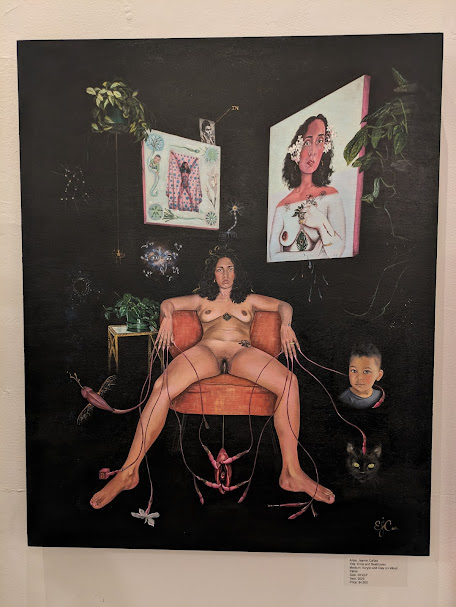
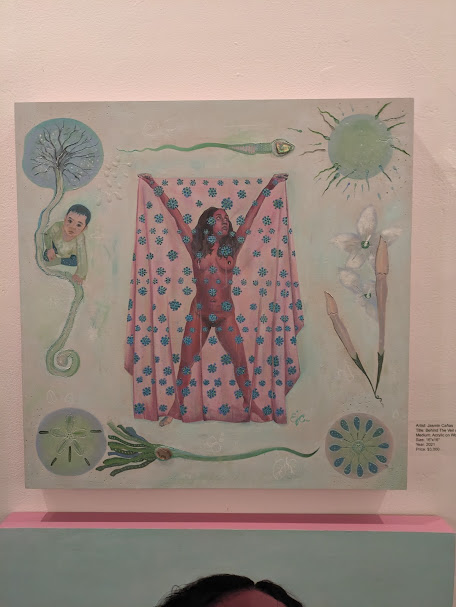
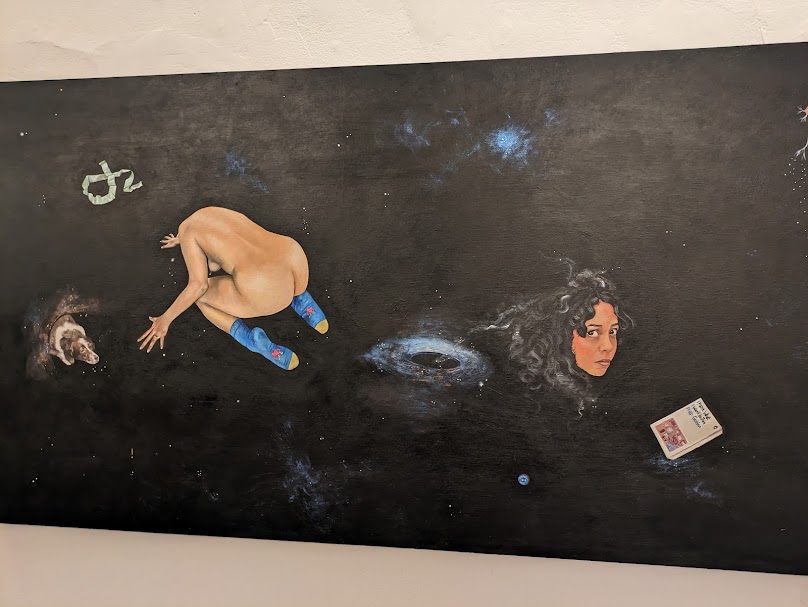
Other notable works are the artist crouched and peeking through what one assumes is a black hole, her body again depicted not as a monolithic object, but what I guess I would describe as a nude Alice in Wonderland, her disembodied head floating near some figures of what perhaps make up her psyche, a very cute Australian Shepard mix lying sadly in the universe on one side, a copy of Philip Guston’s “I Paint What I Want To See” on the other. The next painting, a black void which features the artist splayed nude on an ottoman, surrounded by objects in space that recall fertility, botany, anatomy, and domesticity. Floating nerves, sperm, a gem-like clitoris, a small portrait of Freida Kahlo, an ejaculating phallus with fly wings, houseplants, a cat, a portrait of the artists son, and a smaller version of another portrait in the show, floating around the artist pays homage to Frieda Kahlo’s “Two Freidas” and “What the Water Gave Me”. A beautifully rendered, expressive portrait delights, and a mystical depiction of the artist donning a sheer curtain over her figure intrigues. Also featured are surrealist depictions of the figure in a barren landscape re:Dali , a theme that repeats throughout the exhibit as a monochromatic blue abstraction of the artists body, with disembodied pieces lying scattered throughout the work.
Themes of motherhood are seen throughout other works in the show, at the entrance are three small works of beaded and embroidered sex organs abstracted to look like flowers, they bring to mind Hilma Af Klimt.
Beyond these are painstaking portraits of eyes, the titles bearing names of people in the possesive follow by, “Mother”. Each pair of eyes is complete with a pair of perfectly manicured eyebrows and a full pictorial debut of a reflection in the iris, the layers of color so lovingly wrought.
TLDR; this artist has done her homework, and seeks to create in the purest terms. She pays homage to many of the greats and strikes out on her own in a bust of herself, a breathtaking, meditative, and penetrating portrait. In the presence of these works, I felt the artists sincerity and was star struck by someone so present, so willing to experience all life’s pains and joys, and so exacting in her endeavor to depict them. Surrealism is a major influence of the works and play intermingles with themes around identity, personhood, and celebrations of biology, anatomy, and the miracle of life.



Leave a comment